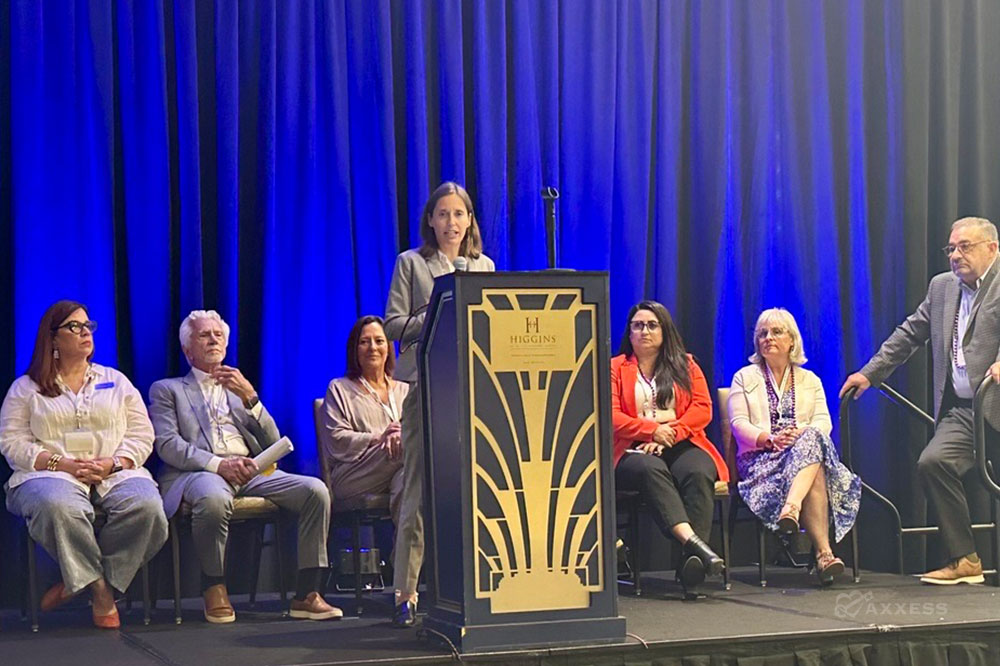
Axxess Director of Hospice Sales Wendy Amerson has built her career at the intersection of clinical operations, compliance, and technology, helping hospice organizations navigate complexity and emerge stronger, more scalable, and better equipped to serve patients.
Recently recognized as a Future Leader by WTWH Healthcare, Wendy is known for turning regulatory change into operational clarity and translating real-world provider needs into smarter systems and workflows.
The Axxess communications team sat down with Wendy to talk about where care in the home is headed and what providers should be thinking about next.
Q: What excites you the most about the future of care in the home?
Wendy:
What excites me most is how much more connected and informed care in the home is becoming. We’re reaching a point where technology can actually support clinical decision-making in real time, instead of just capturing information after the fact. That opens the door to more proactive, personalized care, where clinicians can intervene earlier and make more confident decisions in the moment.
At the same time, there’s a real opportunity to strengthen the human side of care. When technology reduces administrative burden and removes friction from the day, clinicians can focus more on their patients and less on their screens. That balance, where innovation enhances rather than replaces the human connection, is where I think we’ll see the most meaningful progress.
Takeaway:
The future of home-based care is more connected, proactive, and human-centered.
Q: What are you challenging about the future of care in the home?
Wendy:
One of the biggest things I challenge is the idea that care in the home can’t be as sophisticated or as coordinated as care delivered in traditional settings. There’s still a perception that home-based care is inherently limited, when in reality, with the right systems and processes in place, it can be incredibly dynamic, responsive, and high-quality.
I also challenge the belief that more technology automatically means better outcomes. Technology should support clinicians, not complicate their work. If it adds steps or creates confusion, it’s not solving the right problem. The focus has to stay on how we make care delivery more intuitive and sustainable for the people providing it.
And finally, I think we have to move away from the mindset that existing workflows are fixed. Just because something has always been done a certain way doesn’t mean it’s still the best way. The future of care in the home depends on our willingness to rethink those assumptions and design models that better reflect how care is actually delivered today.
Takeaway:
Progress in home-based care starts with challenging outdated assumptions about what’s possible and how care should be delivered.
Q: How can providers and the industry prepare for what’s ahead?
Wendy:
Preparation for what’s ahead starts with a willingness to challenge and rethink long-standing processes. The organizations that are going to be successful aren’t the ones that simply layer new tools onto existing workflows; they’re the ones that step back and ask, “Is this still the best way to do this?”
The future will also require stronger alignment across teams. Clinical, operational, and technology leaders need to be working more closely than ever. When those groups are aligned around a shared vision, decisions are clearer, implementations are smoother, and the outcomes are stronger across the board.
There’s also a mindset component. We have to be open to change, but intentional about it. Not every new tool or trend is the right fit, but when organizations identify the ones that truly support clinicians and improve care delivery, adopting them early and thoughtfully can create a meaningful advantage.
At the end of the day, preparing for the future of care in the home means staying grounded in what matters most: delivering high-quality, compassionate care while being willing to evolve how we get there.
Takeaway:
Preparation requires challenging assumptions, aligning teams, and evolving how care is delivered.
Final Reflection
Wendy’s perspective reflects a broader evolution in home-based care: one defined not just by innovation, but by intentional change. As the industry transforms, leaders like Wendy are challenging assumptions, rethinking workflows, and helping organizations build models that better support both clinicians and patients.
At Axxess, that same focus comes to life through technology designed to simplify workflows and better support care delivery in the real world.