

The Home Health Consumer Assessment of Healthcare Providers and Systems (HHCAHPS) patient engagement survey impacts the bottom line of home health agencies substantially, by attracting referral sources and value-based reimbursement. It is imperative for organizations to understand the HHCAHPS survey, and work on improving each measure to maximize long-term growth and sustainability.
Discussing Medication Frequency– Question 13
Question 13 is one of seven questions included in the Home Health CAHPS survey Specific Care Issues domain, designed to assess how effectively healthcare providers discuss medicines, pain, and home safety with patients.
Specific Care Issues
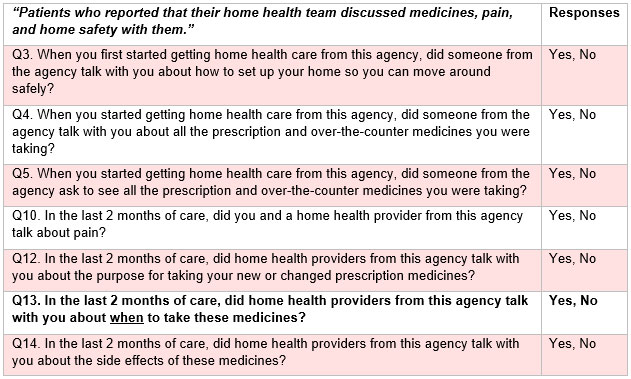
This question evaluates the patient’s perception of whether home health providers discussed when to take any new or changed medications introduced during the patient’s care. This evaluation builds on the initial medication assessment in questions 4 and 5, gauging patients’ knowledge of their medication and its contributions to achieving treatment goals. Optimizing performance on this question relies on an organization’s ability to ensure any changes made to a patient’s medication regimen, including the addition of new medicines or medication adjustments, are routinely accompanied by thorough training on when and how to take medications appropriately.
Suggestions for Improving Specific Care Issues Related to Medications
- Ensure clinicians always request and discuss patient medications at Start of Care, Resumption of Care, and Transfers (M2016).
- Reassess patient medications on each visit, and ensure any changes are addressed.
- Use teaching aids liberally and leave instructional resources in patient homes.
Medication-related issues constitute about 26 percent of hospital readmissions and are therefore a critical component of patient care management. Home healthcare organizations should establish structured procedures for educating patients on when to take their medications, to foster positive outcomes.
AHRQ Health Literacy Universal Precautions Toolkit – Tool #16
The Health Literacy Universal Precautions Toolkit, provided by the Agency for Healthcare Research and Quality (AHRQ), includes a section dedicated to helping patients remember when to take their medications: Tool #16. Several suggestions outlined in the tool are listed below:
- Ask patients how they remember to take medicines. Assessing how patients remember to take their medications can include basic talking points such as: “Do you have a way of remembering to take your medicines?” or “Everyone forgets to take their medicine from time to time. When was the last time you forgot to take any of your medicine?” Regularly revisit the topic of medication frequency with patients to ensure medicine is continuously managed appropriately.
- Use precise instructions for taking medications. Providers responsible for prescribing medications should always write prescriptions using clear, precise language. For example, “one pill in the morning and one pill at bedtime” is more effective than “twice daily.” Systematic, clear language is equally critical when speaking with patients, to prevent errors that can result from misinterpretation or ambiguity. Additionally, asking patients to repeat medication instructions to verify their understanding (teach-back) is a best practice for reducing medication errors.
- Provide medication lists to patients. Electronic Health Record (EHR) software systems should provide medication lists that can be printed and given to patients at transitional points and any time a medication is added or adjusted throughout treatment. Alternatively, a variety of medication list templates can be downloaded online for implementing in agency practices.
- Engage family members/caregivers for assistance. Caregivers can play an important role in medication management. If a patient has trouble remembering to take medications, or otherwise requires assistance adhering to medication regimes, providers can consider enlisting family members or caregivers for support.
- Explore and promote ways your agency can help. Patients may not readily express difficulty remembering to take their medications, so organizations and providers must regularly facilitate discussions on medication management and promote ways they can help.
Medication Reminders
BeMedWise, a program launched by the National Council on Patient Information and Education, provides a resource for patients, titled 10 Tips to Help Remind You to Stay on Schedule. Agencies can give this resource to patients routinely (e.g., in admission materials) to highlight the importance of taking medications correctly and encourage patients to inform providers if they have difficulty remembering to take their medicines. If a patient has difficulty remembering to take medications, providers should help identify and implement a reminder strategy that works for the patient. Examples of medication reminder strategies include the use of a pill box, alarm, calendar, checklist, or mobile application. The patient’s input should guide the process of identifying the best strategy, and providers should remain aware that involving patients in decisions related to their healthcare leads to improved medication-taking behavior and overall positive patient outcomes.
Check our blogs for the series on improving your agency’s HHCAHPS scores by systematically reviewing each of the HHCAHPS questions and sharing opportunities for improvement.